Introduction
Search is fundamentally changing—and traditional SEO strategies are becoming obsolete.
AI-powered search engines like ChatGPT, Perplexity, Claude, and Google's AI Overviews now answer questions directly without sending users to websites. Millions of searches that once generated clicks now generate citations instead. Your content might inform AI responses while your traffic disappears.
This isn't speculative future-talk. It's happening now. Google's Search Generative Experience (SGE) appears on 15-20% of searches and growing. ChatGPT handles over 600 million queries monthly. Perplexity processes 100+ million searches. Traditional SEO metrics—rankings, clicks, traffic—increasingly fail to capture your actual search visibility.
The fundamental equation of SEO has shifted: from "rank high, get clicks" to "get cited, build authority." Companies optimizing for yesterday's search engines watch visibility decline while competitors embracing Answer Engine Optimization (AEO) capture the AI-powered future.
This guide breaks down exactly what's changing in SEO, why traditional strategies fail, and the new optimization approaches that drive visibility in AI search. If your SEO strategy hasn't evolved since 2023, you're optimizing for a search landscape that's rapidly disappearing.
The Shift from Clicks to Citations
The zero-click search problem just got exponentially worse.
Zero-Click Search Amplified
Traditional Google search already featured zero-click results through featured snippets, knowledge panels, and quick answers. AI search amplifies this dramatically:
Traditional Google: ~50-60% of searches result in zero clicks (users find answer without visiting sites)
AI-powered search: ~75-85% of queries answered directly by AI without website visits
When ChatGPT answers "What are the best project management tools for remote teams?" users get comprehensive recommendations, feature comparisons, and use case guidance—all without clicking your carefully optimized comparison article. Your content might inform the response, but you capture zero traffic.
Citation-Based Visibility Replaces Rankings
The new visibility currency: Being cited as a source in AI-generated answers.
Traditional SEO success: Ranking #1 for target keyword = traffic win
AEO success: Being cited by AI engines across multiple related queries = visibility win
Critical difference: A single well-optimized article might rank for 10-20 keywords and drive 1,000 monthly clicks. That same article cited by ChatGPT in 500 daily conversations reaches 15,000 monthly exposures—but Google Analytics shows zero traffic.
Example: B2B SaaS company's comprehensive guide on API authentication gets cited by ChatGPT 300+ times daily. Google Analytics traffic from organic: 50 visits/day. Actual influence: 300 citations + 50 clicks = 350 daily exposures (7× larger reach than traditional metrics suggest)**.
New Success Metrics for the AI Era
Traditional SEO metrics (becoming insufficient):
- Keyword rankings
- Organic traffic
- Click-through rate
- Time on site
- Conversion rate
Essential AEO metrics (new measurement layer):
- Citation frequency: How often AI engines reference your content
- Citation quality: Primary source vs. supporting reference
- Answer accuracy: Whether AI represents your information correctly
- Brand visibility: Mentions across AI platforms (ChatGPT, Perplexity, Claude, Gemini)
- Source authority: Position as authoritative reference vs. commodity source
Measurement challenge: Traditional analytics tools don't track AI citations. New platforms like Profound and GlimpseAI fill this gap, monitoring when and how AI engines cite your content.
"SEO used to be about ranking for keywords. Now it's about being the source AI engines trust when synthesizing answers. The metrics must evolve with the medium." — SEO Strategy Expert
Traffic Attribution Challenges
The dark funnel problem: Users discover you via AI search, then visit directly or search your brand name days later. Traditional analytics attributes conversion to "direct" or "branded search"—missing the AI influence entirely.
Hidden AI attribution signals:
- Spikes in branded search volume (users learned about you from ChatGPT)
- Direct traffic increases (users typing URL after AI mention)
- Short conversion paths (AI pre-qualified visitors convert faster)
- High engagement from low-attribution sources
Strategic implication: Even if AI citations don't show in analytics, they're influencing buying behavior. Optimizing for AI visibility drives business results beyond visible traffic.
Answer Engine Optimization (AEO) Emerges
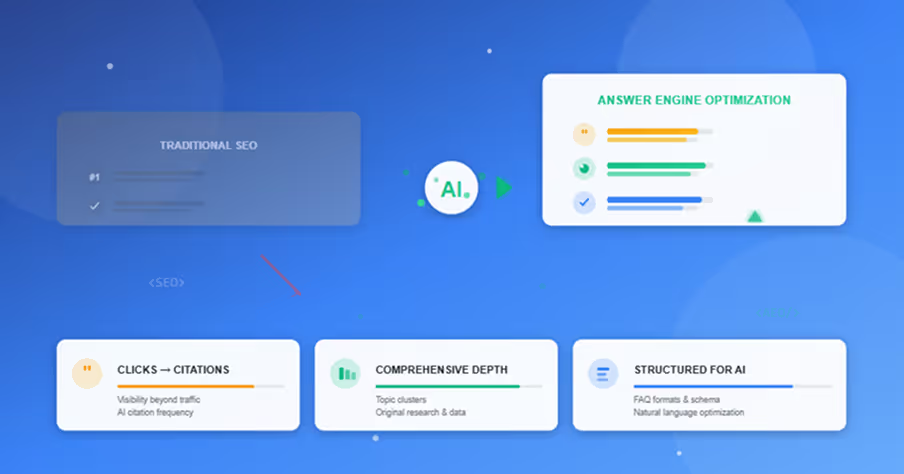
AEO is the evolved SEO strategy for the AI era. While traditional SEO optimizes for Google's algorithm, AEO optimizes for how AI models understand, process, and cite information.
What AEO Means vs. Traditional SEO
Traditional SEO focus:
- Keyword targeting and density
- Title tags and meta descriptions
- Backlink acquisition
- Page speed and technical optimization
- Ranking in top 10 results
AEO focus:
- Structured, parseable content AI can easily extract
- Natural language answers to common questions
- Authoritative, cited information AI trusts
- Original data and research competitors lack
- Being citeable across hundreds of queries (not ranking for 10)
Not replacement, but evolution: AEO builds on SEO foundations. Fast-loading pages with clean structure still matter—but optimization objectives shift from "rank high" to "get cited."
Structured Content for AI Parsing
AI models prefer content organized for easy extraction.
AEO-friendly content structures:
FAQ formats:
Q: What is the best way to...?
A: The most effective approach is... [clear, direct answer]
AI easily extracts question-answer pairs for citations.
Definition and explanation patterns:
[Term] is [clear definition]. This means [explanation in context].
Provides citeable definitions AI can reference confidently.
List-based information:
- Clear hierarchical organization
- Numbered steps for processes
- Bulleted key points
- Scannable subheadings
Data and statistics:
- Specific numbers with sources
- Year/date context
- Clear attribution
Why structure matters: AI models parse content to extract meaning. Unstructured walls of text are harder to cite accurately. Structured content becomes more citeable = higher AI visibility.
Natural Language Optimization
AI understands natural language—keyword stuffing backfires.
Traditional SEO: "Best project management software for small businesses project management tools"
AEO approach: "Small businesses typically need project management software with affordable pricing, simple onboarding, and core features like task tracking and team collaboration."
Optimization shift:
- Write for humans first (AI trained on human language patterns)
- Answer questions thoroughly and conversationally
- Use semantic relationships, not just exact keywords
- Provide context and explanatory depth
Search query evolution: Users ask AI engines complete questions ("What project management tool should I use for a remote team of 10 people with $50/month budget?") rather than keywords ("project management tool"). Content optimized for conversational queries performs better in AI search.
First-Party Sources and Original Data
AI models prioritize authoritative sources with original information.
What makes content citeable:
Original research and data:
- Proprietary surveys or studies
- Industry benchmarks you've collected
- Case study results from your work
- Unique datasets or analysis
First-hand experience:
- "In our analysis of 500 implementations..."
- "Our testing revealed..."
- "Based on our 10-year experience..."
Expert credentials:
- Author bylines with relevant expertise
- Industry certifications or authority
- Demonstrated subject matter knowledge
Why this matters: AI models distinguish between original sources and derivative content. Reporting your own research gets cited. Summarizing others' research gets ignored (AI cites the original).
E-E-A-T for AI Credibility
Google's E-E-A-T framework (Experience, Expertise, Authoritativeness, Trust) now matters for AI citations too.
AI models evaluate source credibility when deciding what to cite:
Experience signals:
- First-person accounts and case studies
- Demonstrated product/service usage
- Real-world implementation examples
Expertise signals:
- Author credentials and bios
- Technical depth and accuracy
- Industry-recognized knowledge
Authoritativeness signals:
- Domain authority and backlinks
- Brand recognition
- Citations from other authoritative sources
Trustworthiness signals:
- Fact-checking and accuracy
- Transparent sourcing
- No misleading claims or clickbait
Strategic imperative: Generic, AI-generated content without expertise fails AEO. AI engines cite authoritative sources demonstrating genuine knowledge—not commodity content.
Content Strategy Transformation
Effective content strategy for AI search looks fundamentally different.
Topic Clusters Over Individual Keywords
Traditional approach: Target individual keywords with dedicated pages
- "project management software" → one optimized page
- "best project management tools" → separate page
- "project management for remote teams" → another page
AEO approach: Build comprehensive topic clusters
- Pillar page: "Complete Guide to Project Management Software"
- Supporting content: features comparison, use case guides, implementation tutorials, integration guides
- Internal linking connects all related content
Why this works for AI: AI models synthesize information from multiple sources. Comprehensive topic coverage across interlinked content signals authority. AI more likely to cite the source with deepest expertise.
Comprehensive Coverage Requirements
AI favors content that thoroughly addresses topics from multiple angles.
Insufficient for AEO (thin content):
- 500-word blog post scratching surface
- Generic information available everywhere
- Single perspective on complex topic
Optimized for AEO (comprehensive content):
- 2,000+ word guides with multiple sections
- Multiple perspectives and use cases
- Original insights not found elsewhere
- Related questions and subtopics addressed
- Visual aids, examples, and data
Depth signals authority: When AI encounters your content addressing questions from every angle, it becomes the go-to source for that topic cluster.
FAQ Formats and Conversational Content
People ask AI engines direct questions—content should mirror this.
High-AEO-value content formats:
Extensive FAQ sections:
- Address 15-30 common questions
- Provide complete answers (not teases)
- Use natural question phrasing
- Cover related subtopics
How-to guides and tutorials:
- Step-by-step instructions
- Troubleshooting sections
- Common mistakes and solutions
- Prerequisites and requirements
Comparison content:
- Feature-by-feature analysis
- Use case recommendations
- Pros and cons evaluation
- Decision frameworks
Interview and expert roundup formats:
- Multiple expert perspectives
- Direct quotes (highly citeable)
- Diverse viewpoints on topic
Why conversational content wins: AI models trained on natural language dialogue. Content structured as questions and answers, explanations, and conversations aligns with how AI processes and generates responses.
Authoritative Depth Signals
Demonstrating authority makes content more citeable.
Authority indicators AI recognizes:
- Citations to research and data: "According to [source], ..."
- Statistical evidence: Specific numbers with context
- Case studies and examples: Real-world application
- Technical accuracy: Precise, correct information
- Industry terminology: Proper use of domain language
- Acknowledged limitations: "This approach works best for... but not for..."
Avoid authority-damaging patterns:
- Vague generalizations without evidence
- Outdated information
- Factual errors (AI may detect and avoid citing)
- Overpromising or clickbait
- Lack of depth or analysis
Technical SEO Evolution
Technical optimization remains crucial—but priorities shift.
Structured Data and Schema Markup
Schema markup becomes more important for AI parsing.
Essential schema types for AEO:
- Article schema: Helps AI identify content type, author, publish date
- FAQ schema: Explicitly marks question-answer pairs
- How-to schema: Structures step-by-step instructions
- Organization schema: Establishes brand authority
- Breadcrumb schema: Shows content hierarchy
Why schema matters for AI: Structured data provides explicit semantic meaning that AI models can parse with confidence. Content with proper schema gets cited more accurately.
Implementation: Use Google's Structured Data Markup Helper or Schema.org documentation to add appropriate schema to all content.
API Accessibility for AI Crawlers
AI models may access content through APIs, not just web crawling.
Optimization considerations:
- Clean HTML structure (AI parses semantic HTML)
- Accessible content (not hidden behind JavaScript rendering)
- Sitemap.xml accuracy (helps AI find all content)
- Robots.txt doesn't block essential content
- RSS/JSON feeds for dynamic content
Emerging practice: Some companies provide dedicated API endpoints for AI search engines to access structured content directly—ensuring accurate citations.
Performance Still Matters
Page speed and Core Web Vitals remain ranking factors, affecting:
- Google search rankings (which influence baseline visibility)
- User experience for traffic that does visit
- Perceived credibility (slow sites feel less authoritative)
AEO impact: While AI citations don't require page speed, sites that rank well traditionally also get cited more by AI (correlation between Google authority and AI trust).
Mobile-First to AI-First Indexing
Google's indexing evolution: Desktop → Mobile-first → AI-first (emerging)
AI-first optimization:
- Content optimized for extraction and synthesis
- Clear information hierarchy
- Scannable structure with subheadings
- Quotable statistics and insights
- Author credentials and context
Strategic shift: Design content not just for human reading, but for AI understanding and citation.
The New SEO Metrics That Matter
Measuring success in AI-powered search requires new analytics.
Citation Frequency Tracking
Metric: How many times AI engines cite your content daily/weekly/monthly
Tools: Profound, GlimpseAI, manual testing
Target: Increasing citation frequency = growing AI visibility
Brand Mention Monitoring
Metric: How often your brand appears in AI responses (with or without direct links)
Measurement: Social listening tools, brand monitoring platforms, manual queries
Indicator: Brand mentions in AI responses drive branded search and direct traffic
Answer Accuracy Verification
Metric: Percentage of AI citations that accurately represent your information
Process: Regular testing of AI responses for your topic areas, validating accuracy
Quality signal: High accuracy = AI trusts your content as reliable source
Source Authority Measurement
Metric: Are you cited as primary source or supporting reference?
Evaluation: Position in citation lists, frequency of "according to [your brand]" attribution
Goal: Become the go-to source AI engines reference first for your expertise area
Traditional Metrics Still Matter
Don't abandon traditional SEO metrics entirely:
- Organic traffic (still valuable, though declining as percentage of visibility)
- Keyword rankings (baseline authority signal)
- Backlinks (credibility indicator AI models likely consider)
- Engagement metrics (time on site, bounce rate for traffic that arrives)
Integrated approach: Track both traditional SEO metrics and new AEO metrics for complete visibility picture.
Conclusion
AI is rewriting the rules of search visibility—and SEO must evolve or become irrelevant.
The shift from clicks to citations, the rise of Answer Engine Optimization, and new content requirements aren't future trends—they're the current reality. Companies still optimizing solely for Google rankings miss the 75-85% of search activity happening in AI-powered environments.
Successful SEO strategy in 2025 and beyond:
- Optimize for being cited, not just ranking
- Create comprehensive, authoritative content AI engines trust
- Structure content for AI parsing and extraction
- Measure citation frequency alongside traditional metrics
- Build original research and expertise competitors can't replicate
The competitive advantage goes to companies who adapt fastest. While competitors debate whether AI search matters, early adopters capture citation share and build authority in AI-powered search environments.
Action steps:
- Audit current content for AEO readiness (structured, comprehensive, authoritative?)
- Implement citation tracking to measure AI visibility
- Develop topic clusters with original research and data
- Add schema markup to all content
- Test your visibility in ChatGPT, Perplexity, Claude, and Google AI Overviews
The future of SEO is already here—just unevenly distributed. Companies embracing AEO now will dominate search visibility while competitors wonder where their traffic went.
Frequently Asked Questions
Is traditional SEO dead because of AI search?
No—traditional SEO evolves, not dies.
What remains important:
- Google still processes 8.5 billion searches daily
- Traditional rankings still drive significant traffic
- Backlinks still signal authority (to both Google and AI)
- Technical SEO fundamentals (site speed, mobile optimization) still matter
- Quality content still wins (whether for Google or AI citations)
What's changing:
- Success metrics expand beyond rankings and clicks to include citations
- Optimization approach adds AEO strategies to SEO foundations
- Content requirements deepen (comprehensive, authoritative, structured)
- Visibility measurement now includes AI search platforms
Strategic approach: Build on traditional SEO strengths while adding AEO capabilities. Companies doing both capture maximum search visibility across traditional and AI-powered environments.
Reality: Traditional SEO isn't dead—it's insufficient alone. Complete search strategy requires both SEO and AEO optimization.
How do I track if AI search engines are citing my content?
Tracking methods (from simple to sophisticated):
1. Manual testing (free, time-intensive):
- Query ChatGPT, Perplexity, Claude with questions your content answers
- Document when your brand/content is cited
- Test weekly for ~20 representative queries
- Track patterns over time in spreadsheet
Limitation: Labor-intensive, misses citations you don't manually discover
2. Citation monitoring tools (automated):
- Profound ($99-199/month): Tracks citations across ChatGPT, Perplexity, Claude
- GlimpseAI (pricing varies): Real-time AI search visibility monitoring
- Automated alerts for citation changes
- Competitive benchmarking
3. Proxy metrics (indirect signals):
- Branded search volume increases (users discovering you via AI, then Googling brand)
- Direct traffic spikes (users typing URL after AI mention)
- Referral traffic from AI platforms (when they include links)
4. Google Search Console (partial view):
- Monitor Google AI Overviews impressions
- Track featured snippet appearances (correlates with AI citations)
Recommended approach: Start with weekly manual testing to establish baseline, invest in Profound or similar tool when scaling AEO efforts. Combine with traditional analytics for complete visibility picture.
What content changes should I prioritize for better AI citations?
High-impact AEO improvements (prioritized by effort vs. impact):
Quick wins (high impact, low effort):
- Add comprehensive FAQ sections to existing top-performing content (15-30 questions per article)
- Implement schema markup (FAQ schema, Article schema, Organization schema)
- Add author bios with credentials to establish E-E-A-T
- Update with recent data (AI prefers current information)
Medium-term improvements (high impact, moderate effort):5. Restructure content with clear subheadings and scannable hierarchy6. Add original data or case studies to existing guides7. Expand thin content (500 words → 2,000+ words with comprehensive coverage)8. Create topic clusters around your core expertise areas
Long-term investments (highest impact, significant effort):9. Develop proprietary research (surveys, studies, benchmarks) competitors can't replicate10. Build authoritative pillar content (5,000-10,000 word comprehensive guides)11. Establish thought leadership through interviews, expert roundups, unique perspectives
Don't do: Generic AI-generated content without expertise. AI engines cite authoritative sources, not commodity content.
Testing approach: Implement changes on 5-10 high-value pages, monitor citation frequency changes over 30-60 days, scale successful approaches across remaining content.
Should I optimize for Google or AI search engines?
Both—they're not mutually exclusive.
Integrated optimization strategy:
Foundations that work for both:
- High-quality, authoritative content
- Fast page speed and technical optimization
- Mobile-responsive design
- Clean site structure and navigation
- Comprehensive topic coverage
Google-specific optimization:
- Traditional keyword targeting
- Backlink acquisition
- Meta descriptions and title tags
- Ranking in top 10 results
AI-specific optimization (AEO):
- Structured, parseable content
- FAQ formats and conversational language
- Original research and data
- Citation frequency measurement
- Natural language answers
Reality: Content optimized for AI citations often ranks better in Google too. Comprehensive, authoritative, well-structured content performs in both environments.
Resource allocation: If starting fresh, 60% traditional SEO + 40% AEO provides balanced approach. For established sites with strong Google rankings, shift incrementally toward 50/50 as AI search grows.
Future-proofing: AI search share increasing rapidly. Starting AEO optimization now positions you for continued visibility as search behavior evolves—while competitors scramble to catch up later.